Why the Sun and the Moon Never Meet
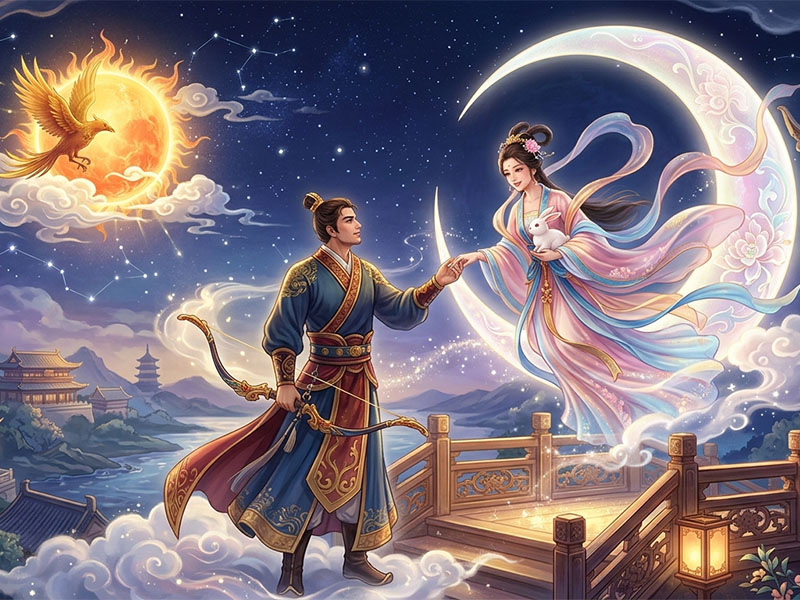

It may seem surprising, but this natural phenomenon—why the Sun and the Moon never meet—can be explained very simply. However, in ancient times, people knew very little about astronomy, and that is why beautiful legends were born.
One day, I decided to make a video about Chinese folklore and found many interesting and romantic tales originating from China and the peoples who live there.
The Legend of the Sun, the Moon, and the Evil Sorcerer (Witch)
This is a legend of the Yi people, who live in southern China.
Once upon a time, there were two lovers—a beautiful girl named A-mi and a brave young man named A-lo. They were inseparable and were planning to get married.
An evil and powerful sorcerer (in some versions, an evil witch or a cruel ruler of the underworld or mountain kingdom) envied their happiness and wanted the girl for himself. When she rejected him, the sorcerer flew into a rage and decided to separate the lovers forever, ensuring that they would never be able to touch one another.
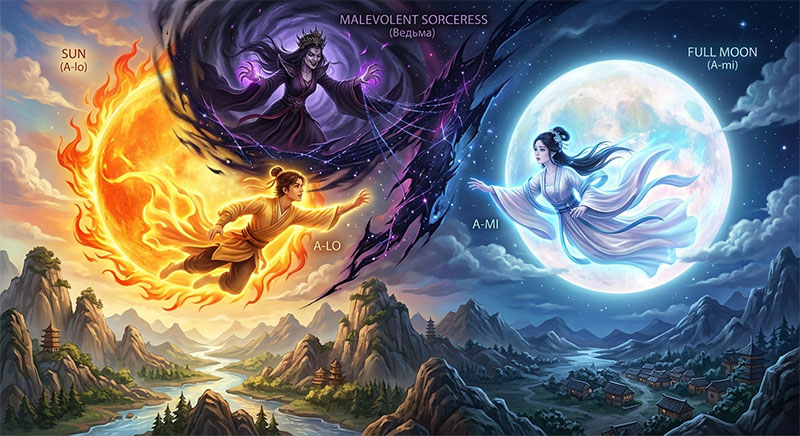
He turned the young man A-lo into the Sun, destined to warm the earth by day. He turned the young woman A-mi into the Moon, which was to shine in the darkness of night.
Eternal Separation and Eclipses
The sorcerer cast a curse: one was to take the other’s place in the sky, so that they would search for each other forever but could never meet.
However, love proved stronger than magic. The young man, the Sun, and the young woman, the Moon, found a way to circumvent the curse. When their longing becomes unbearable, they disrupt the celestial order and draw close to embrace each other for a moment—at that moment, people on Earth witness a solar or lunar eclipse. And the stars in the night sky are the sparks of their unending love or the tears of the Moon, who longs for her beloved.
The Legend of Hou Yi and Zhang Ye
There are no witches or sorcerers here, but there is the tragic fate of two lovers. The most beautiful and poetic story from China.
The Mid-Autumn Festival is still celebrated in honor of this couple (during which it is customary to eat moon cakes and admire the full moon).
Part 1: Ten Suns and a Great Feat
Long, long ago, there was not just one Sun in the sky, but ten of them. They were the sons of the heavenly ruler and took turns ruling the sky. But one day they grew tired of this routine and decided to all rise into the sky at once.
All hell broke loose on Earth:
Rivers dried up instantly, crops withered, the earth cracked, and people began to die from the unbearable heat and hunger.
Then Hou Yi—the most skilled and courageous divine archer—came to humanity’s aid. He climbed to the top of a high mountain, took out his magical bow, and began shooting down the suns one by one. He aimed precisely at their hearts, and the suns he shot down fell to the earth in the form of three-legged golden crows.
Hou Yi shot down nine suns and was already raising his arrow toward the last one, but the emperor stopped him just in time, asking him to leave one sun so that the world would not be plunged into eternal darkness and cold. Thus, order was restored to the Earth, and Hou Yi became the greatest hero.
Part 2: Chang’e and the Elixir of Immortality
For his heroic deed, Hou Yi received a great reward from the Goddess of the West (Xi Wangmu)—the elixir of immortality. But there was one catch: the vial contained just enough magic that if two people drank it, they would gain eternal youth and a long life on Earth. But if only one person drank it, they would instantly become a god and ascend to the heavens.
Hou Yi loved his beautiful wife Chang’e madly and did not want to part with her for the sake of the heavenly palace. He returned home, gave the vial to his wife to keep, and decided that they would simply share it later so they could live happily on Earth.
Part 3: Betrayal and the Flight to the Moon
Hou Yi had many disciples who envied his fame. One of them, a cunning and malicious man named Peng Meng, learned of the elixir.
One day, when Hou Yi went hunting with the other disciples, Peng Meng pretended to be sick, stayed home, and, breaking into Chang’e’s chambers, demanded that she hand over the magical potion. Chang’e knew she could not defeat such a powerful warrior. To prevent the elixir from falling into the villain’s hands, she made a desperate decision—she drank it all herself, down to the last drop.
As soon as she did so, her body became as light as air. Zhang E lifted off the ground and rushed toward the open window, soaring higher and higher toward the stars. She loved her husband so deeply that she did not want to fly away to the distant heavenly realm of the gods; instead, she chose the celestial body closest to Earth—the Moon—so she could be as close as possible to her beloved.
Part 4: A Bitter Memory
When Hou Yi returned home and learned what had happened, he was inconsolable. He cried out into the night sky, calling for his wife, and suddenly noticed that the moon that night was unusually bright, round, and clear, and that a silhouette resembling his beloved Chang’e was visible on it.
Hou Yi then ordered a table to be set up in the garden and had Chang’e’s favorite fruits and sweets laid out on it as a sign that he still loved her and was waiting for her.
Upon learning of Chang’e’s tragic fate, people also began making offerings to the moon, asking it for peace, prosperity, and family reunions. And so the Mid-Autumn Festival was born.
Грустная деталь: Считается, что на Луне Чан Э живет не одна. Компанию ей составляет Нефритовый заяц (Юй ту), который в своей ступе вечно толчет снадобье бессмертия, пытаясь создать рецепт, который позволит Чан Э вернуться обратно на Землю к своему мужу.
The Story of Nyulan (the Shepherd) and Zhinu (the Weaver)
This legend could be called the Chinese Valentine’s Day—the Qixi Festival (celebrated on the 7th day of the 7th lunar month).
This is an incredibly romantic story about how, for the sake of love, an ordinary shepherd defied the will of the Heavenly Empress herself.
Part 1: A Meeting by the River
Nyulan was a simple, kind, and very poor shepherd on Earth. He had nothing but his faithful old ox.
Zhina was the seventh daughter of the Heavenly Empress. She lived in heaven and wove beautiful, multicolored brocade from clouds and starlight, which adorned the sky. She was incredibly bored in heaven, and one day, together with her sisters, she descended to Earth to bathe in a clear lake (or the Silver River).
The old ox Nyulan turned out to be a magical creature (a former star god exiled to Earth). He spoke in a human voice and told the shepherd where the heavenly maidens were bathing, adding that if Nyulan took the clothes of one of them, she would stay with him on Earth.
Nyulan went to the lake and took Zina’s dress. When her sisters became frightened and flew away, Zina remained. Looking at Nyulan, she saw his kind heart and fell in love. She decided not to return to the heavens.
Part 2: A Happy Life and the Wrath of Heaven
They got married and lived in love and harmony for several wonderful years. Nyulan worked in the fields, and Zhinu wove clothes for the family, and soon they had two wonderful children—a boy and a girl.
But time flows differently in Heaven. Soon, the Heavenly Empress noticed that the heavens had grown dim, for her best weaver had disappeared. Glancing down at Earth, she flew into a rage upon realizing that an immortal goddess had married a mere mortal, violating the sacred laws.
The Empress personally descended to Earth, seized Zhina, and forcibly dragged her back to heaven.
Part 3: The Chase and the Silver River
Nyulan returned home to find his children in tears. At that moment, his old ox, who was already dying of old age, said to the shepherd: “When I die, take my hide off me. If you put it on, you’ll be able to rise into the sky and catch up with your wife.” With a heavy heart, Nyulan did just that.
He placed the children in two baskets, hung them from the yoke, put on the ox’s hide, and soared into the sky. He had almost caught up with the Empress and Zina, and the children were already shouting, “Mom! Mom!”
Seeing that the mortal was about to catch up with them, the Heavenly Empress took her golden hairpin from her hair and drew it forcefully across the sky. Instantly, a turbulent, impassable Silver River (as the Chinese call the Milky Way) spread out across that spot.
Nulan remained on one bank, and Jinu on the other. They could see each other, but could not step across the cosmic stream. Jinu wept bitterly on her bank, weaving anew only a gray tapestry of tears, while Nulan and the children yearned on theirs.
Part 4: The Bridge of Magpies
Their love and ceaseless weeping moved even the hardened hearts of the birds. Myriads of magpies from all over the world flocked to the Silver River. They flapped their wings and formed a living bridge spanning the Milky Way, soaring through space.
Seeing such devotion, the Heavenly Empress softened her heart a little. She allowed the lovers to meet once a year—on the seventh night of the seventh lunar month (the Qixi Festival).
Astronomical fact: Zinu is the star Vega, and Nyulan is the star Altair. In the summer and early fall, they can indeed be seen in the sky on opposite sides of the Milky Way. And the two little stars next to Altair are the very children in baskets that the shepherd carries on his yoke.
In China, it is said that if there is a light rain on the night of the Qixi Festival, those are not raindrops but the tears of joy shed by Nulan and Zhi Nu, who were finally able to embrace each other on a bridge made of magpie wings.